On the long weekend in Victoria, we took the van to Seymour - about 110km north of home.
The trip was uneventful, with the PHEV just able to maintain charge while we traveled about 100km/h.
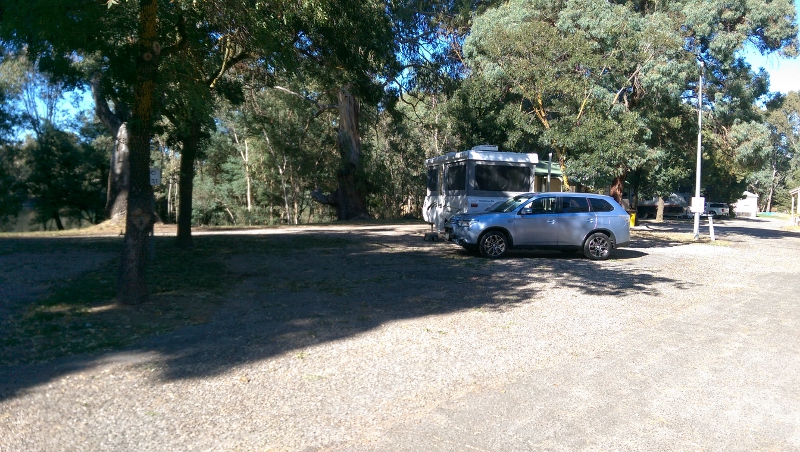
The Goulburn River Caravan Park at Seymour.
We had a meeting in Shepparton - about 80km further on so left the van at Seymour and drove up and back to Shepparton the following day.
Towing economy was 12.1 l/100km and non-towing was 6.1 l/100km - at least for the trip up to Shepparton. The trip back was 10.2 l/100km.
Everyone but us cleared out early Monday morning. We stuck around until about midday.
I parked the PHEV in as close to a tree as possible so kids couldn't squeeze between the vehicle and the tree and bend the charge flap (known problem). It also helped to hide the charge cable so we avoided any issues...
I have bought a new OBD2 dongle which works fine but didn't get a chance to monitor anything yet.
Filled at Seymour. ODO 13961. 28.45 L.
Caravan distance: 240km.
The blog describes our trips and experiences towing a Goldstream Crown camper around with our Mitsubishi Outlander Plug in Hybrid Electric Vehicle (PHEV).
Friday, March 24, 2017
Thursday, March 2, 2017
Battery Condition - October 2016
This is a retrospective post but I'll leave the post date correct.
Using EvBatMon for the PHEV and Android and a cheap eBay OBD2 dongle, I grabbed this snapshot of the PHEV's battery condition a day or two after we picked it up on 11th October 2016.
Shortly after I grabbed this pic the dongle died - I wasn't too surprised.
I have a more expensive one on the way.
I was pretty happy with the 92.63% battery condition estimate as I was expecting around 93%.
Labels:
Battery
Monday, February 20, 2017
Castlemaine to home.
We fully charged the PHEV overnight. We intended to stay around for most of Sunday but impending rain saw us pack up, hitch up and go in search of a late breakfast/lunch.
(This picture taken when we arrived and it was sunny.)
I left our site and immediately hit "save". Shortly after the battery range was around 37km (we normally see 48km when not towing).
We stopped for lunch and when we restarted, I allowed the PHEV to run battery powered until the range got down to around 15km again - then hit "save". This time it gradually dropped to 10km then stayed there.
The trip home involved a drop of about 500 meters overall for the 150km trip. We still had 10km remaining when we backed into our driveway at home - I should have used the battery energy but I wanted some spare.
Since it was just plain cold on Sunday, my better half had the heater on for the entire trip home. Her side was set to 25 degrees. It was anywhere from 11 to 14 degrees outside. Since our PHEV is the standard ZJ (not Aspire), we don't have engine coolant heating so it was all electric. While it subtracted 10km off the electric range (when the aircon button was pressed) I don't believe it impacted the overall economy much.
The trip home showed us 10.6 l/100km petrol usage. (The trip to Castlemaine used 11.1 l/100km). I'm really happy with that petrol consumption (a bit of battery help notwithstanding). The Super Snipe would have used over 20 l/100km going up the Calder. Other folks have quoted similar figures towing up the Calder in modern 4WDs.
Now the interesting bits.
Using the Info->Trip vehicle energy flow graphic (not ours) and the Power meter on the left of the speedo cluster (below), the following observations were made.
The power meter (left gauge) has a 90 degree wide section of the dial coloured green. I'll call the point where it transitions from Charge to Eco (blue to green), 0 degrees. Needle vertical I'll call 90 degrees.
(These picture are not from our PHEV.)
All the following observations were made at 100km/h on cruise control (so my foot didn't mess it around to much - the hills provide the slow moving input). Save or Charge didn't appear to matter.
At 100 km/h the motor is coupled to the front wheels in all cases.
From 0 to 40 (or 45) degrees (power meter needle) the motor also charges the battery - very slowly.
From 45 to around 60 degrees the battery is not used or charged at all.
From 60 degrees up, the battery is called upon to help run the vehicle.
This changes if you slow down. The speed at which the following takes place varies depending on the size of the hill (the load).
So at slower speeds (~=80km/h) or higher power demand, the motor uncouples from the front wheels, starts reving a lot and confines itself to running the generator. The wheels are then powered from the battery/generator. Essentially it becomes a CVT. This strategy appears to be because the motor can not provide as much generator power at lower revs (I'm guessing about 2500-2600RPM for 100km/h while the engine is coupled to the front wheels) so is better off un-coupling from the wheels and running the generator at higher RPM.
I'd love to know what the generator power is - I can't appear to find anything about it - I suspect 60kw.
I'll be using this blog to log ODO and petrol fillups from now on so:
First ever fill ODO13228
Castlemaine: ODO 13699, 26.44 L(Unl91).
Caravan distance: ~300km
(This picture taken when we arrived and it was sunny.)
I left our site and immediately hit "save". Shortly after the battery range was around 37km (we normally see 48km when not towing).
We stopped for lunch and when we restarted, I allowed the PHEV to run battery powered until the range got down to around 15km again - then hit "save". This time it gradually dropped to 10km then stayed there.
The trip home involved a drop of about 500 meters overall for the 150km trip. We still had 10km remaining when we backed into our driveway at home - I should have used the battery energy but I wanted some spare.
Since it was just plain cold on Sunday, my better half had the heater on for the entire trip home. Her side was set to 25 degrees. It was anywhere from 11 to 14 degrees outside. Since our PHEV is the standard ZJ (not Aspire), we don't have engine coolant heating so it was all electric. While it subtracted 10km off the electric range (when the aircon button was pressed) I don't believe it impacted the overall economy much.
The trip home showed us 10.6 l/100km petrol usage. (The trip to Castlemaine used 11.1 l/100km). I'm really happy with that petrol consumption (a bit of battery help notwithstanding). The Super Snipe would have used over 20 l/100km going up the Calder. Other folks have quoted similar figures towing up the Calder in modern 4WDs.
Now the interesting bits.
Using the Info->Trip vehicle energy flow graphic (not ours) and the Power meter on the left of the speedo cluster (below), the following observations were made.The power meter (left gauge) has a 90 degree wide section of the dial coloured green. I'll call the point where it transitions from Charge to Eco (blue to green), 0 degrees. Needle vertical I'll call 90 degrees.
(These picture are not from our PHEV.)
All the following observations were made at 100km/h on cruise control (so my foot didn't mess it around to much - the hills provide the slow moving input). Save or Charge didn't appear to matter.
At 100 km/h the motor is coupled to the front wheels in all cases.
From 0 to 40 (or 45) degrees (power meter needle) the motor also charges the battery - very slowly.
From 45 to around 60 degrees the battery is not used or charged at all.
From 60 degrees up, the battery is called upon to help run the vehicle.
This changes if you slow down. The speed at which the following takes place varies depending on the size of the hill (the load).
So at slower speeds (~=80km/h) or higher power demand, the motor uncouples from the front wheels, starts reving a lot and confines itself to running the generator. The wheels are then powered from the battery/generator. Essentially it becomes a CVT. This strategy appears to be because the motor can not provide as much generator power at lower revs (I'm guessing about 2500-2600RPM for 100km/h while the engine is coupled to the front wheels) so is better off un-coupling from the wheels and running the generator at higher RPM.
I'd love to know what the generator power is - I can't appear to find anything about it - I suspect 60kw.
I'll be using this blog to log ODO and petrol fillups from now on so:
First ever fill ODO13228
Castlemaine: ODO 13699, 26.44 L(Unl91).
Caravan distance: ~300km
Labels:
Castelmaine
Picking up the van and First trip - Castlemaine
With the PHEV now sporting a new RedArc electric brake controller and a 12 pin trailer socket wired for 12V caravan battery and fridge (both courtesy of Boronia Auto Electrical Service - no affiliation but they did a great job), we picked up the new van on Thursday from Pakenham, about 50km east of home. The electrics were perfect!
The old weight distribution hitch (WDH) from the Super Snipe was on the wrong angle and I nearly had a hernia putting the first bar (of four) on the PHEV. So we bought a Hayman Reece chain type WDH from Goldstream and fitted it. It gave us nice control over the ball weight.
Fully loaded I reckon the van is just under the maximum rated towing load for the PHEV - 1500kg.
It should be noted that at no time did I "run out of power". I'll document my conclusions after the next post describing our drive back home the following day and my more-intense observations about what the PHEV graphics told me was going on.
*The Outlander PHEV has two big button near the handbrake marked "SAVE" and "CHRG".
SAVE attempts to hold the battery State Of Charge at about the same value it was when you engaged save.
CHRG attempts to charge the battery up to around 85% then hold it at that point.
If neither of these buttons are engaged the PHEV uses all the accessable battery power then holds it at a minimum value (around 27% - but gauge says empty).
The old weight distribution hitch (WDH) from the Super Snipe was on the wrong angle and I nearly had a hernia putting the first bar (of four) on the PHEV. So we bought a Hayman Reece chain type WDH from Goldstream and fitted it. It gave us nice control over the ball weight.
Fully loaded I reckon the van is just under the maximum rated towing load for the PHEV - 1500kg.
Saturday came around and our first trip out with the van was to Castlemaine, about 150km north by north west of where we live in Melbourne's eastern suburbs.
That meant going up the Calder highway, which is not a steep climb but it's a slow sneaks-up-on-you climb that goes on for many kilometers. On hot days, the Super Snipe always got pretty hot (engine wise) on a Calder trip - so it's a good test. Other folk at work have also noted that it's a petrol sucking climb for the first 45 minutes when towing.
Fully charged, we ran on battery power from home (plus a bit of petrol - more later) until the remaining EV range was 15km then switched to "save"* mode. At this point we had only travelled 15km. For the next 15 minutes, the EV range gradually dropped to 10km then recovered to 12 then down to 10km again. I had to stop shortly after hitting the Calder to adjust towing mirrors (another story) and I shut the car off while I got out - mistake!
When I re-started the PHEV, save mode was off and before I knew it I had 7km of EV remaining. We hadn't really started the slow Calder climb yet...
(An known annoyance with the PHEV is that it does not "remember" that you hit save when you power it off then on again.)
I hit "Save" but 15 minutes later we were down to 3 km EV range then another 10 minutes - none. I switched to "Charge" but the battery range stayed steadfastly on "--.--" for the rest of the drive up the Calder highway. It wasn't until we finally slowed to 60 km in Castlemaine an hour later that we got back 4km of battery range.
It should be noted that at no time did I "run out of power". I'll document my conclusions after the next post describing our drive back home the following day and my more-intense observations about what the PHEV graphics told me was going on.
*The Outlander PHEV has two big button near the handbrake marked "SAVE" and "CHRG".
SAVE attempts to hold the battery State Of Charge at about the same value it was when you engaged save.
CHRG attempts to charge the battery up to around 85% then hold it at that point.
If neither of these buttons are engaged the PHEV uses all the accessable battery power then holds it at a minimum value (around 27% - but gauge says empty).
Labels:
Castelmaine
Monday, January 9, 2017
Why the PHEV?
Our previous caravan tow-car was a 1967 Humber Super Snipe. We had it for 17 years and it towed our first two caravans (campers), a Goldstream Star II and later a Goldstream Storm.
The Humber dragged them safely and reliably up to Coffs Harbour (we are in Melbourne), the Blue Mountains near Sydney and various other places up the east coast of Australia.
The picture show (some of) us with the Super Snipe and Star II camper with the Parkes Radio telescope visible in the distant background.
The Super Snipe had no air conditioning so with that and Vinyl seats (faux leather?), it wasn't comfortable in the summer heat - especially long trips inland.
We recently sold the Super Snipe, still going strong, to someone who we know will take good car of her. Curiously they will be towing an A-Van.
With the kids pretty much not wanting to go caravaning any more we looked hard and finally decided to sell the Goldstream Storm and buy a camper without the pull-out beds - the Goldstream Crown. It will be easier to setup with only two of us. Our Crown will be ready for pick-up in mid February 2017.
Since my daily driver is a DIY Electric (http://electricvogue.blogspot.com.au/) and Mrs EV's car is a Honda Insight (hybrid) we needed a tow car.
Mrs EV had been toying with the idea of replacing the Insight with a Mitsubishi Outlander PHEV (Plug in Hybrid Electric Vehicle) so she could be 100% electric for her drive to/from work - but didn't really like the idea of such a big vehicle for day-to-day travel. We both have difficulties with folk who drive around in 2 tonne plus vehicles with one person in them - perhaps a bit harsh but we didn't want to join the SUV/4WD commuter crowd.
So the idea of getting a PHEV and replacing the Super Snipe in the garage and using the PHEV for towing (and a spare for the 0.1% times I need longer range) was interesting. Add to that, it's an ideal vehicle to sit around with the petrol motor not running since it's designed to be a car where the petrol motor doesn't run for long periods of time. So the Mitsubishi Outlander PHEV - kind of had us hooked.
The Humber dragged them safely and reliably up to Coffs Harbour (we are in Melbourne), the Blue Mountains near Sydney and various other places up the east coast of Australia.The picture show (some of) us with the Super Snipe and Star II camper with the Parkes Radio telescope visible in the distant background.
The Super Snipe had no air conditioning so with that and Vinyl seats (faux leather?), it wasn't comfortable in the summer heat - especially long trips inland.
We recently sold the Super Snipe, still going strong, to someone who we know will take good car of her. Curiously they will be towing an A-Van.
With the kids pretty much not wanting to go caravaning any more we looked hard and finally decided to sell the Goldstream Storm and buy a camper without the pull-out beds - the Goldstream Crown. It will be easier to setup with only two of us. Our Crown will be ready for pick-up in mid February 2017.
Since my daily driver is a DIY Electric (http://electricvogue.blogspot.com.au/) and Mrs EV's car is a Honda Insight (hybrid) we needed a tow car.
Mrs EV had been toying with the idea of replacing the Insight with a Mitsubishi Outlander PHEV (Plug in Hybrid Electric Vehicle) so she could be 100% electric for her drive to/from work - but didn't really like the idea of such a big vehicle for day-to-day travel. We both have difficulties with folk who drive around in 2 tonne plus vehicles with one person in them - perhaps a bit harsh but we didn't want to join the SUV/4WD commuter crowd.
So the idea of getting a PHEV and replacing the Super Snipe in the garage and using the PHEV for towing (and a spare for the 0.1% times I need longer range) was interesting. Add to that, it's an ideal vehicle to sit around with the petrol motor not running since it's designed to be a car where the petrol motor doesn't run for long periods of time. So the Mitsubishi Outlander PHEV - kind of had us hooked.
Labels:
History
Subscribe to:
Posts (Atom)


